

AI-powered capsule endoscopy is becoming the new standard for diagnosing gastrointestinal diseases in 2025. The innovative method combines a miniature video capsule with advanced machine-learning algorithms, enabling doctors to detect pathologies with sensitivity of up to 98% and shorten analysis time by a factor of 15 — from 33.7 to 3.8 minutes. The technology has already been adopted by medical institutions in Belarus, Kazakhstan, Uzbekistan, and other post-Soviet countries, opening a new era of precise medical diagnostics.
How AI-powered capsule endoscopy works
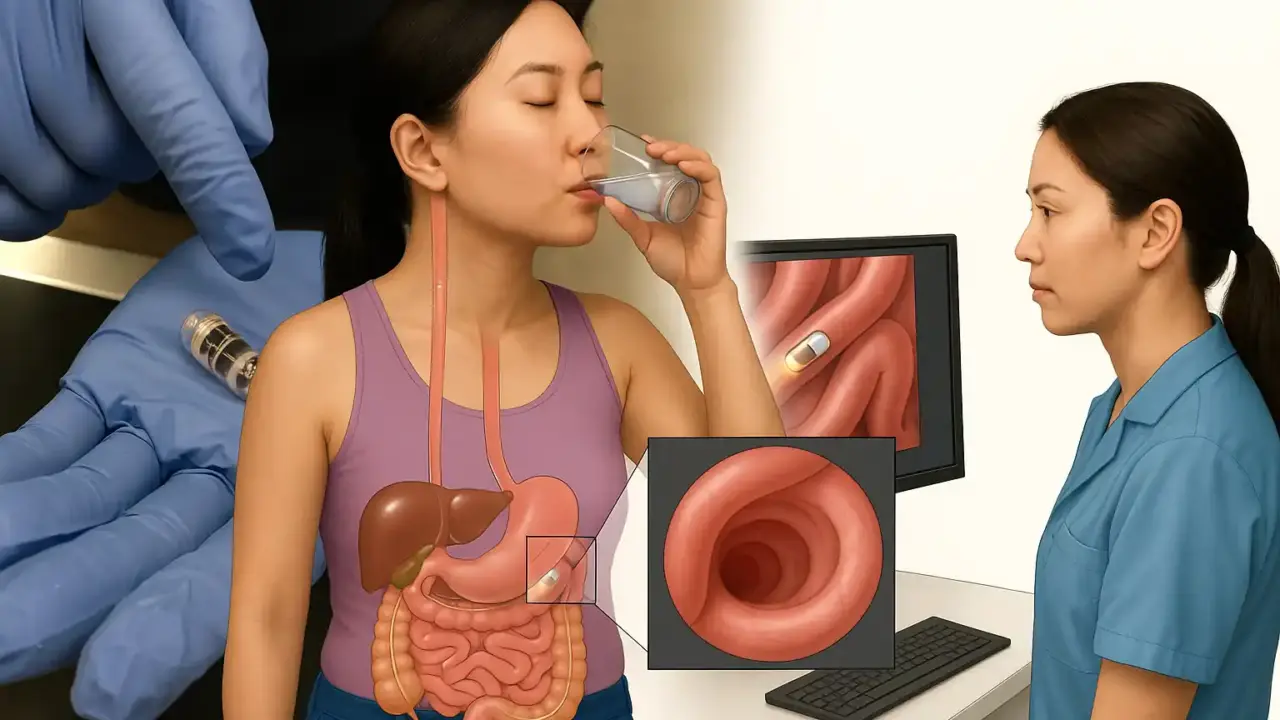
AI-powered capsule endoscopy is a synthesis of hardware and software innovation. The patient swallows a capsule measuring 11×26 millimetres — roughly the size of a large vitamin tablet or a gummy candy. Inside it sits a miniature high-resolution camera, LED lighting, batteries, a microchip, and a wireless data transmitter.
A special slippery coating makes swallowing comfortable, and once in the oesophagus the patient does not feel the device at all. The capsule moves through the gastrointestinal tract naturally thanks to peristalsis — the wave-like contractions of the digestive system’s walls.
Over the 8–12 hours of its journey through the digestive tract, the capsule produces between 50,000 and 60,000 high-quality images, covering every section of the intestine. Modern PillCam Crohn’s systems provide a 344-degree field of view thanks to two cameras placed on each side of the capsule. Exclusive adaptive frame-rate technology takes 4 to 35 frames per second depending on the capsule’s speed.
The images are transmitted to sensor-antennas attached to the patient’s abdomen, which forward the data to a recording device (receiver) worn on a special belt around the waist. Some newer models work without external sensors. After the 8–12-hour recording cycle, the patient removes the equipment and returns it to the doctor for analysis.
The capsule exits the body naturally with stool 1–7 days after being swallowed. Foreign bodies up to 7 centimetres usually pass on their own, and the capsule is only 1×3 centimetres with a very smooth rounded surface. There is no need to track its exit — it disposes of itself naturally in the toilet, since all data has already been recorded on the receiver. In rare cases (less than 1%) the capsule may be retained due to narrowing or obstruction in the intestine, which is itself an important diagnostic finding.
Capsule endoscopy is becoming an alternative to traditional colonoscopy for patients with contraindications, anaesthesia intolerance, or a psychological barrier to invasive procedures. The method does not require hospitalisation, sedation, or anaesthesia, lets patients continue their normal activities during the examination, and entirely eliminates infection risk thanks to the single-use capsule.
You may also be interested in:
- Robotic surgery in 2025: Stryker MAKO system used in Uzbekistan by Kazakhstani specialists
- Artificial intelligence opens a new learning algorithm in 2025
- Magnetically controlled nanobots: a revolution in cancer treatment
Sources:
- Nature Biomedical Engineering: New capsule endoscopy improves cancer detection
- Frontiers in Artificial Intelligence: Artificial intelligence-assisted capsule endoscopy for detecting CD
- Global RPh: The Rise of Capsule Endoscopy in the Era of AI Analysis


Comments on this article