

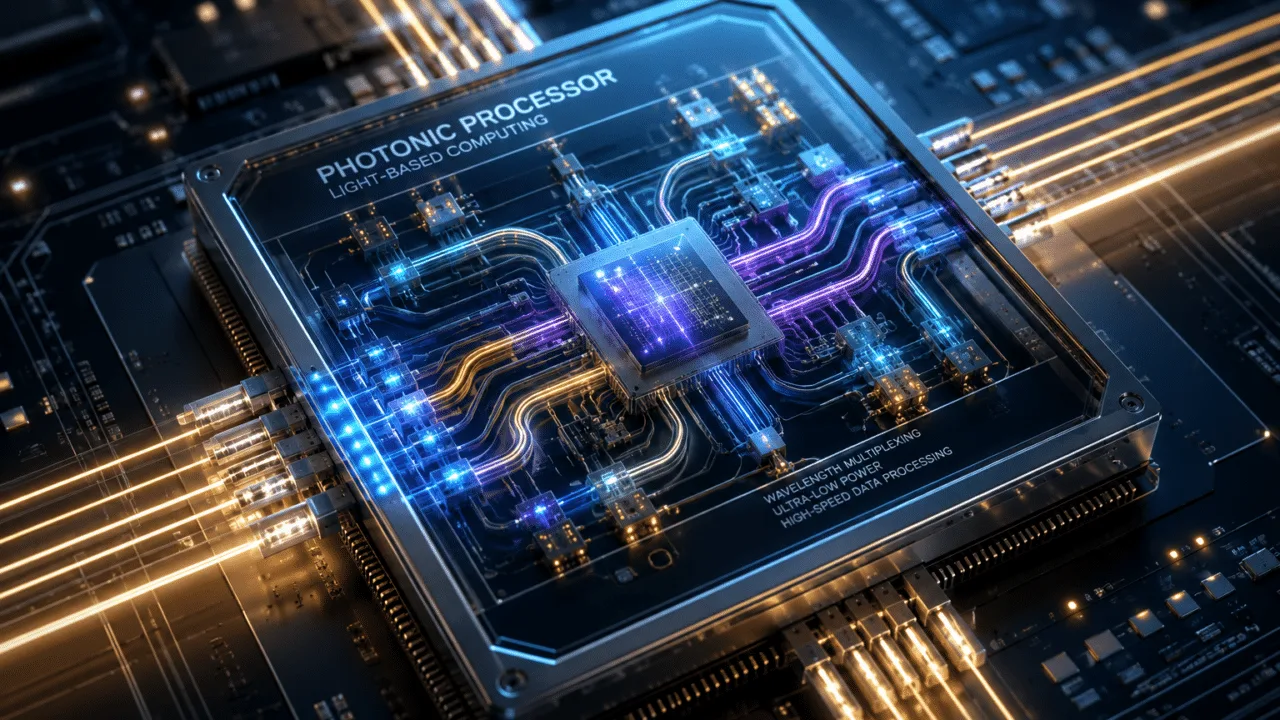
While the world remains focused on the rapid advancement of artificial intelligence and the record-breaking demand for NVIDIA accelerators, China has taken a step that could eventually have an impact on the computing industry comparable to the invention of the first microprocessors. A new photonic computing research laboratory has officially opened in Shanghai, dedicated to a technology that many experts consider one of the strongest candidates for the next generation of computing systems.
According to The Next Web, the new research center will focus on developing computing systems that use light instead of electrical signals. Traditional computers process information through the movement of electrons inside semiconductor chips, while photonic systems rely on photons — particles of light. Although this may sound like another scientific experiment, many researchers believe that photonic computing could become the foundation of future artificial intelligence systems, supercomputers, and global digital infrastructure.

Why Modern Computers Are Approaching Their Limits
For decades, advances in computing performance have been driven by shrinking transistor sizes. Engineers have successfully packed billions of electronic components onto a single chip, making processors increasingly powerful. However, the semiconductor industry is now facing significant physical limitations. As computing power increases, chips generate more heat and require substantially more energy to operate efficiently.
This challenge has become particularly evident with the rise of artificial intelligence. Modern large language models and neural networks demand enormous computing resources. Some of the world’s largest data centers already consume as much electricity as small cities, while the cost of AI training infrastructure is measured in millions of dollars. As a result, leading technology companies are actively searching for alternative approaches to computing.
What Is Photonic Computing and Why Does It Matter?
Photonic computing proposes replacing electrons with light as the primary medium for processing and transmitting information. Photons travel significantly faster, generate minimal heat, and can carry massive amounts of data simultaneously. In theory, this could enable computing systems that operate faster than today’s processors while consuming far less energy.
Experts believe that the combination of speed and energy efficiency makes photonic computing particularly attractive for artificial intelligence applications. Many computational tasks that currently require thousands of GPUs could eventually be performed by specialized photonic chips more quickly and at a lower cost. This potential has attracted growing interest from both researchers and technology companies around the world.
Could Photonic Computing Challenge NVIDIA and the GPU Market?
Today, NVIDIA is the dominant supplier of computing power for the artificial intelligence industry. Most leading AI projects depend on the company’s graphics processors to train and deploy neural networks. However, some analysts believe that photonic processors could become one of the first technologies capable of disrupting the current balance of power in the computing market.
That does not mean data centers will replace GPUs with photonic solutions tomorrow. The technology remains in the research and experimental stage. Nevertheless, the history of computing shows that major technological revolutions often begin with projects that initially seem highly specialized. Twenty years ago, few people imagined that graphics processors would become the foundation of artificial intelligence. Today, modern AI systems would be impossible without them.
Why China Is Investing in Photonic Computing
As reported by South China Morning Post, China views photonic computing not only as a scientific initiative but also as part of a broader strategy aimed at achieving technological independence. As global competition intensifies in advanced semiconductor technologies, nations are increasingly searching for breakthroughs that could provide a long-term advantage.
The establishment of a dedicated laboratory indicates that research in this field is moving to a new level. Universities, research institutions, and technology companies are collaborating to develop next-generation photonic processors. In practical terms, China is positioning itself to become a leader in a field that could influence the future of computing throughout the second half of the 21st century.
What Could This Mean for Everyday Users?
At first glance, research into photonic computing may seem distant from everyday life. However, history shows that breakthroughs in computing technology eventually affect nearly every aspect of society. Faster and more energy-efficient systems could accelerate drug discovery, improve climate modeling, enhance transportation networks, and enable entirely new generations of artificial intelligence applications.
Lower energy consumption in data centers could also make cloud services more affordable and accessible. In the long term, this may allow companies to deploy increasingly sophisticated AI systems without dramatically increasing infrastructure costs. For businesses, this means new opportunities for automation and innovation. For consumers, it could result in faster, smarter, and more capable digital services.
When Could Photonic Processors Reach the Market?
Despite growing interest from both industry and academia, widespread adoption of photonic computing is unlikely to occur within the next few years. Most existing solutions remain experimental, and engineers still face significant challenges related to manufacturing, scalability, and integration with existing computing infrastructure.
Even so, many experts believe that the first commercial photonic accelerators designed for specialized workloads could appear within the next five to ten years. If these expectations prove accurate, the world could witness one of the most significant technological transformations since the rise of modern semiconductor technology.
Conclusion
The opening of China’s new photonic computing laboratory may prove to be far more important than it initially appears. This is not simply another research center; it represents an effort to build the foundation for the next generation of computing technologies. If scientists successfully unlock the full potential of photonic processors, future computers could process information faster, consume less energy, and enable capabilities that today still seem like science fiction. For this reason, many experts already consider photonic computing one of the most promising technological fields of the coming decades.




Comments on this article