

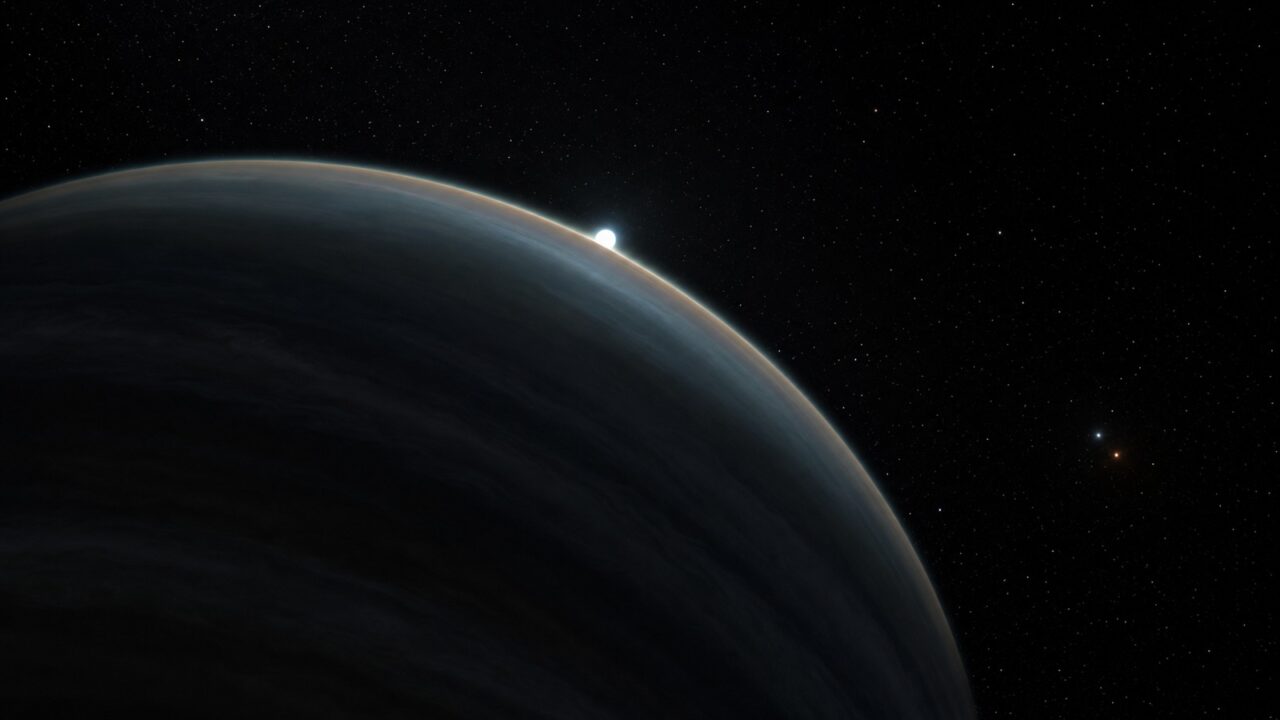
St Andrews, United Kingdom. The James Webb Space Telescope has detected an atmosphere around the gas giant WD 1856 b, which orbits a white dwarf — the compact remnant of a Sun-like star. It is the first atmospheric detection for a planet transiting a white dwarf, ESA/Webb reported.
The international study led by Ryan MacDonald of the University of St Andrews was published in the peer-reviewed journal Nature on 1 July. The spectrum revealed hydrocarbons, primarily methane, aerosol particles and thermal emission from the planet’s nightside.
What is WD 1856 b?
WD 1856 b lies about 80 light-years from Earth. Its radius is roughly 0.9 times Jupiter’s, while the white dwarf WD 1856+534 is comparable in size to Earth. The planet is therefore about seven times wider than the star it orbits.
One orbit takes about 34 hours. Its orbital radius is roughly 0.02 astronomical units, or less than 3 million kilometres. The planet could not have occupied this location before the star became a white dwarf: the expanding red giant should have engulfed it.
TESS and Spitzer discovered the object in 2020. Until the new observations, its mass remained uncertain, leaving open whether it was a planet or a more massive brown dwarf and how it reached such a tight orbit.
The eight minutes that revealed an atmosphere
Webb observed the system on 27 April 2023 with its NIRSpec spectrograph in PRISM mode. The full sequence lasted 1.98 hours, but the grazing transit itself took only eight minutes as the edge of the giant planet partially covered the small star.
During the transit, some white-dwarf light passed through the upper atmosphere of WD 1856 b. Molecules absorbed particular wavelengths, leaving characteristic bands in the spectrum. Webb simultaneously measured infrared radiation emitted by the planet itself.
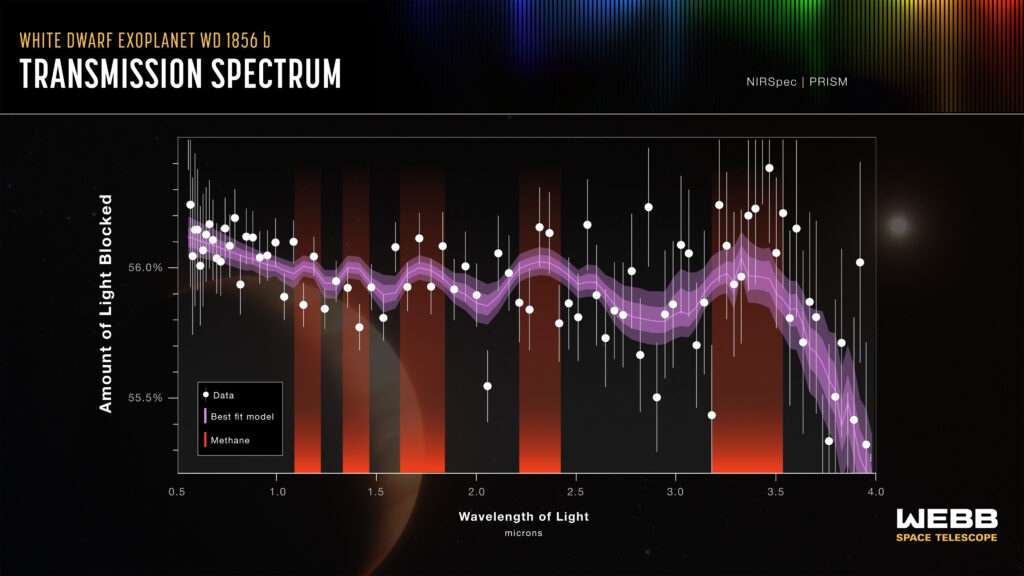
Methane detected, cloud composition unresolved
Analysis across 0.5–5 micrometres revealed several hydrocarbon bands. The authors identify methane as the preferred explanation and estimate an abundance of about 7%. They also found strong evidence for aerosols — small particles forming clouds or haze.
The present data cannot identify the particles’ chemical composition. The model contains tentative signs of ethane and phosphine, but the researchers explicitly say these do not constitute detections. The atmosphere and methane are supported much more strongly than those additional molecules.
The planet is unexpectedly warm
Spectral analysis constrained WD 1856 b’s mass to 4.3–10.9 Jupiter masses, confirming its planetary status. Its effective temperature is 390–412 kelvin, roughly 117–139°C. By comparison, the equilibrium temperature expected from white-dwarf light alone is about 160 kelvin.
The excess heat cannot be explained by ongoing tidal heating on the present nearly circular orbit. The authors argue that the planet retains residual energy from an event that occurred long after the star died.
How WD 1856 b survived the red giant
The team compared two principal scenarios. In one, the planet entered the dying star’s common gaseous envelope and survived. In the other, it initially remained on a safe wide orbit before other bodies pushed it onto a highly eccentric path. Two distant companion stars may have contributed to that disturbance, but their role has not been directly demonstrated.
Cooling models place the reheating event 3–5.5 billion years after the end of the asymptotic giant branch phase. That late timing is inconsistent with a common-envelope event during stellar death and favours high-eccentricity migration. As the planet moved inward, tides raised by the white dwarf heated it and gradually circularised its orbit.
The conclusion relies on a backward reconstruction of thermal history and current substellar cooling models. The authors describe late migration as the most likely explanation, while noting that future models should reproduce both the temperature and radius of WD 1856 b.
Related space coverage: read about the evidence for a lost ice giant in the early Solar System and the astronomy discoveries that changed black-hole research.
A glimpse of the Solar System’s future
In about 5 billion years, the Sun will become a red giant and then a white dwarf. Mercury and Venus will be destroyed, while Earth’s fate remains uncertain. The more distant gas giants may survive but later shift their orbits through gravitational interactions.
WD 1856 b is not an exact model of Jupiter’s future, but it demonstrates that a giant planet can persist after stellar evolution and enter a new orbit billions of years later. Cifrum.kz previously examined how the moons of Jupiter and Uranus can preserve evidence of the giant planets’ early history.
The team has already observed four additional transits of WD 1856 b. Those data should refine the atmospheric chemistry and cloud properties. The University of St Andrews describes the result as the start of a new line of research into planetary systems after their stars die.
Sources: the Nature research article, ESA/Webb, NASA Science and the University of St Andrews.
The lead image was created with artificial intelligence for Cifrum.kz as a conceptual editorial illustration. The official spectrum was released by ESA/Webb under CC BY 4.0 with full attribution.




Comments on this article