

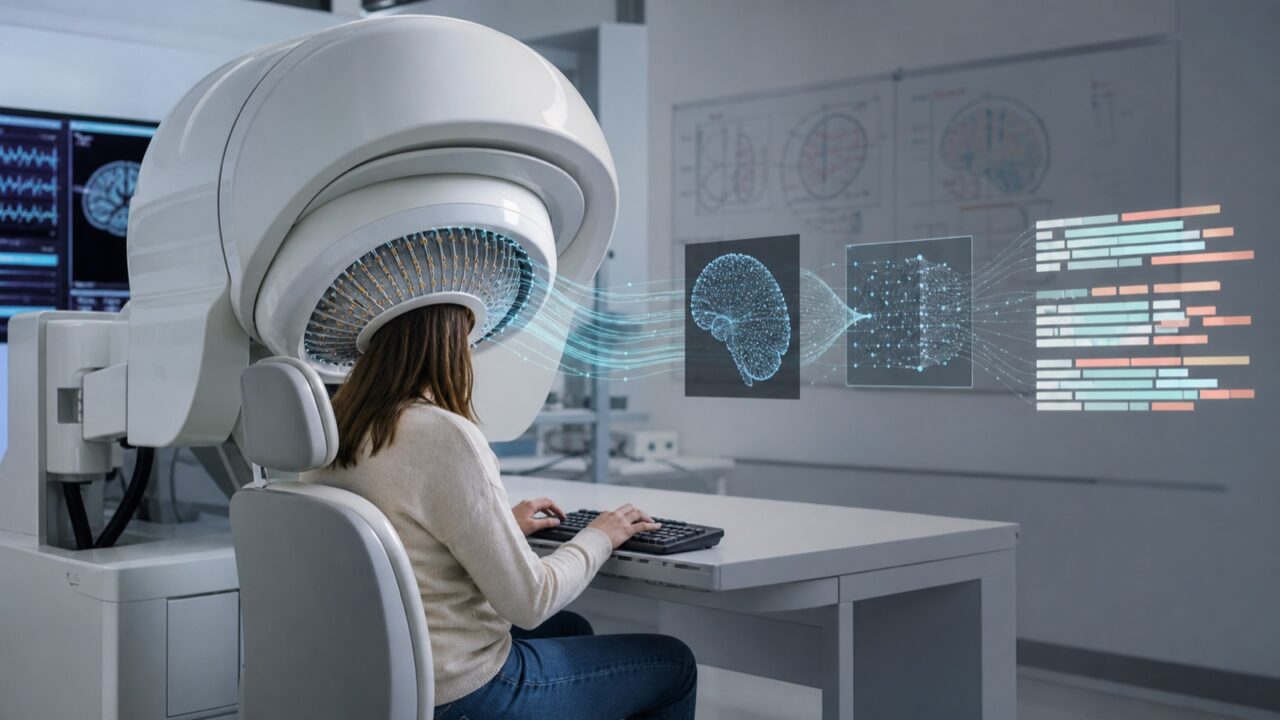
Meta on June 29 unveiled Brain2Qwerty v2, a research system designed to decode sentences a person is typing from continuous brain-activity recordings captured with magnetoencephalography. According to Meta’s official announcement, average word accuracy reached 61% in the experiment and rose to 78% for the best-performing participant.
The system does not read arbitrary or hidden thoughts. Healthy volunteers first heard prepared sentences and, after a delay, typed them on a keyboard while inside a MEG scanner. Brain2Qwerty v2 analysed brain activity during this controlled typing task.
How the Brain2Qwerty v2 study was conducted
The Brain2Qwerty v2 preprint says researchers collected about 22,000 sentences from nine healthy participants. Each volunteer spent approximately ten hours in a MEG device, producing roughly 90 hours of recordings in total.
Magnetoencephalography does not require surgery: sensors outside the head measure weak magnetic fields generated by neural activity. Unlike the first version, which required the timing of every keystroke, the new system processes a continuous signal and is designed for sentence generation in near-real-time conditions.
How the system turns signals into text
The architecture combines three modules. The first extracts representations related to characters and keystrokes from continuous MEG recordings. The second aligns segments of the neural signal with word representations. A fine-tuned large language model then generates the final sentence using both preliminary character predictions and information derived from MEG.
The authors also used AI agents to explore improvements to the system’s code. Meta says engineers, rather than an autonomous system, selected the final training configurations.
What the 61% and 78% figures mean
The preprint reports an average word error rate, or WER, of 39%, equivalent to 61% word accuracy. Accuracy reached 78% for the best participant; Meta says more than half of that person’s sentences were recovered with no more than one word error.
These figures apply to nine participants and a specific experimental protocol. As with other narrow AI benchmark comparisons, the result cannot automatically be extended to every task or treated as evidence that the technology is ready for practical use.
The language model can produce coherent but incorrect sentences
The fine-tuned language model helps recover coherent sentences from noisy data, but it also introduces a distinct failure mode. The preprint notes that when signal quality was insufficient, the system could generate a grammatically plausible sentence that differed substantially from the target. Such an error would be critical in a medical communication interface.
How v2 differs from the first version published in Nature
On the same day as the v2 announcement, Nature Neuroscience published the peer-reviewed study of the first Brain2Qwerty. That work involved 35 healthy volunteers and decoded individual characters from MEG and EEG data. The final paper reports an average character error rate of 29% for MEG and 65% for EEG, with the best MEG participants reaching an error rate as low as 18%.
The two sets of figures are not directly comparable: the Nature paper measures character error rate, while the principal v2 result is presented as word accuracy. Brain2Qwerty v2 is also currently a preprint and has not yet undergone separate journal peer review.
Important limitations remain before clinical use
Brain2Qwerty v2 was tested in healthy people, not patients who had lost the ability to speak or move. The developers acknowledge that accuracy is still insufficient for everyday communication. The MEG scanner used in the study is also large and expensive, making it inaccessible to most clinics and patients.
Meta presents the work as a possible direction for future non-invasive brain–computer interfaces. The published results do not establish the existence of a finished medical device; they describe an experimental research pipeline.
The code is public, while the v2 data remain unavailable
Meta has released the training code for Brain2Qwerty v1 and v2 on GitHub. The Basque Center on Cognition, Brain and Language published the first-version dataset on Hugging Face. According to the project page, the v2 dataset will remain under embargo until the paper is accepted.
Sources: Meta AI, official Brain2Qwerty project page, v2 preprint, Nature Neuroscience, GitHub.
The image was generated with artificial intelligence for Cifrum.kz and is conceptual. It does not show Meta equipment or a clinical procedure.


Comments on this article