

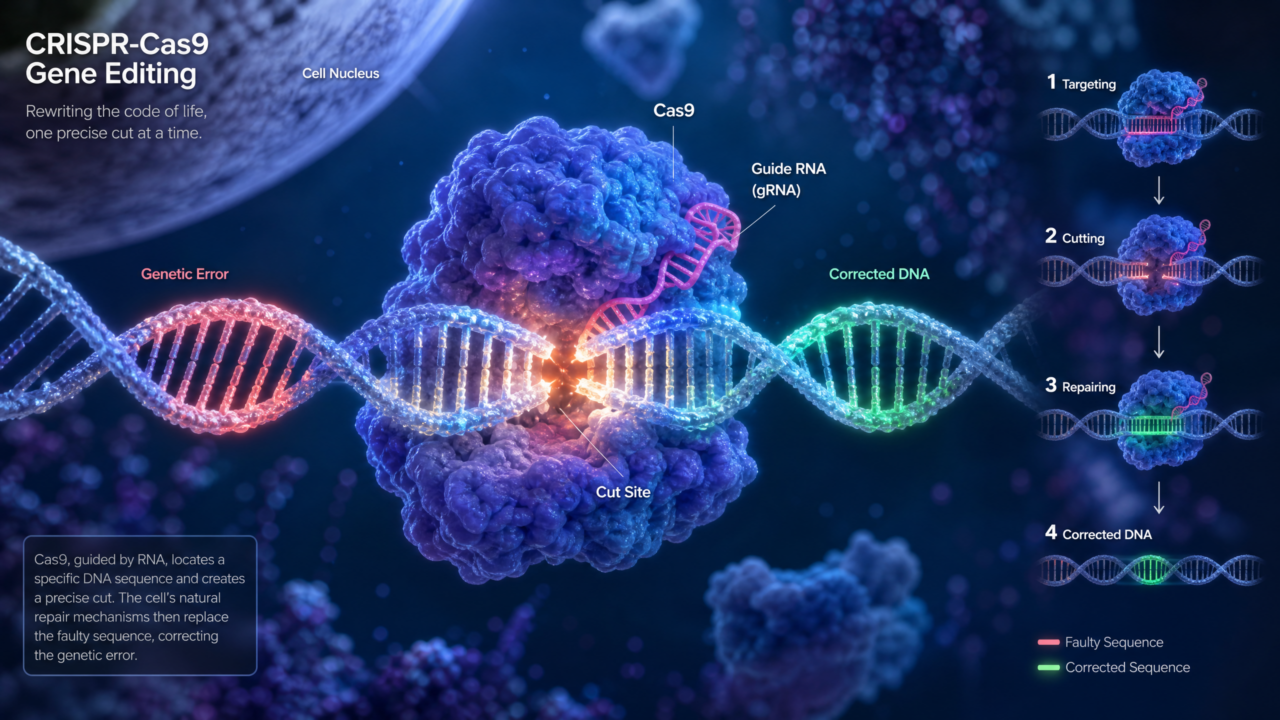
ISTANBUL / CAMBRIDGE, MA — An international team of scientists has announced the completion of the first-ever large-scale Phase 3 clinical trial of a CRISPR gene-editing treatment delivered directly inside the human body. The results, presented at the European Academy of Allergy and Clinical Immunology (EAACI) congress, confirm that a single infusion can potentially cure a rare genetic disease.
Success Statistics
The randomized, double-blind study involved 80 patients with hereditary angioedema (HAE) — a life-threatening condition characterized by unpredictable and severe swelling. The investigational therapy, lonvoguran-ziclumeran (lonvo-z) by Intellia Therapeutics, demonstrated phenomenal efficacy:
- The rate of monthly attacks was reduced by 87% compared to the placebo group.
- 62% of treated patients remained entirely attack-free after a single dose.
- The need for on-demand rescue therapy dropped by 89%.
Expert Insights
“This is the first time CRISPR technology has been successfully applied systemically within a large Phase 3 trial. We are seeing more than just improvement; we are seeing the potential for a one-time functional cure for a chronic condition,” said Dr. Danny Cohn of Amsterdam University Medical Centers (UMC), who led the research.
The findings were simultaneously published in the prestigious The New England Journal of Medicine (NEJM). Researchers emphasized the safety profile of the method: side effects were mostly mild and transient, and long-term follow-up from Phase 1 and 2 trials confirms the effect remains stable for over four years.
What Does This Mean for Medicine?
Intellia Therapeutics’ success paves the way for the regulatory approval of the world’s first in vivo gene-editing drug. Unlike previous “ex vivo” methods, where a patient’s cells are edited in a lab and then re-infused, this new approach allows DNA to be “fixed” directly in the patient’s liver through a standard intravenous infusion.
Experts believe this marks the beginning of a new era in treating thousands of hereditary disorders that were previously considered incurable.
Source: Intellia Therapeutics, NEJM




Comments on this article