


NASA’s X-59 research aircraft continues its series of test flights over Armstrong Flight Research Center in Edwards, California. On April 28, 2026, the aircraft conducted a low-altitude, reduced-speed flight as part of the Quesst mission, which is focused on studying quiet supersonic flight.
The X-59 and the Quesst Mission: What’s Behind the Tests
The experimental X-59 aircraft is being developed by NASA under the Quesst program, which aims to explore the possibility of reducing the sonic boom during supersonic flight. A distinctive feature of the aircraft is its unusually long, tapered nose, which engineers designed to significantly alter the nature of the acoustic impact on the ground. The program involves collecting data that could potentially influence regulatory frameworks governing civilian supersonic air travel.
From High Speeds to a Full Range of Conditions
According to NASA, the X-59 has already completed its initial test flights at high altitudes and near-supersonic speeds. The successful completion of that phase opened the door to the next stage — evaluating the aircraft’s performance across a broader range of conditions. As stated in agency materials, the current series of flights is focused specifically on low altitudes and reduced speeds.
What Low-Speed Flights Are Testing
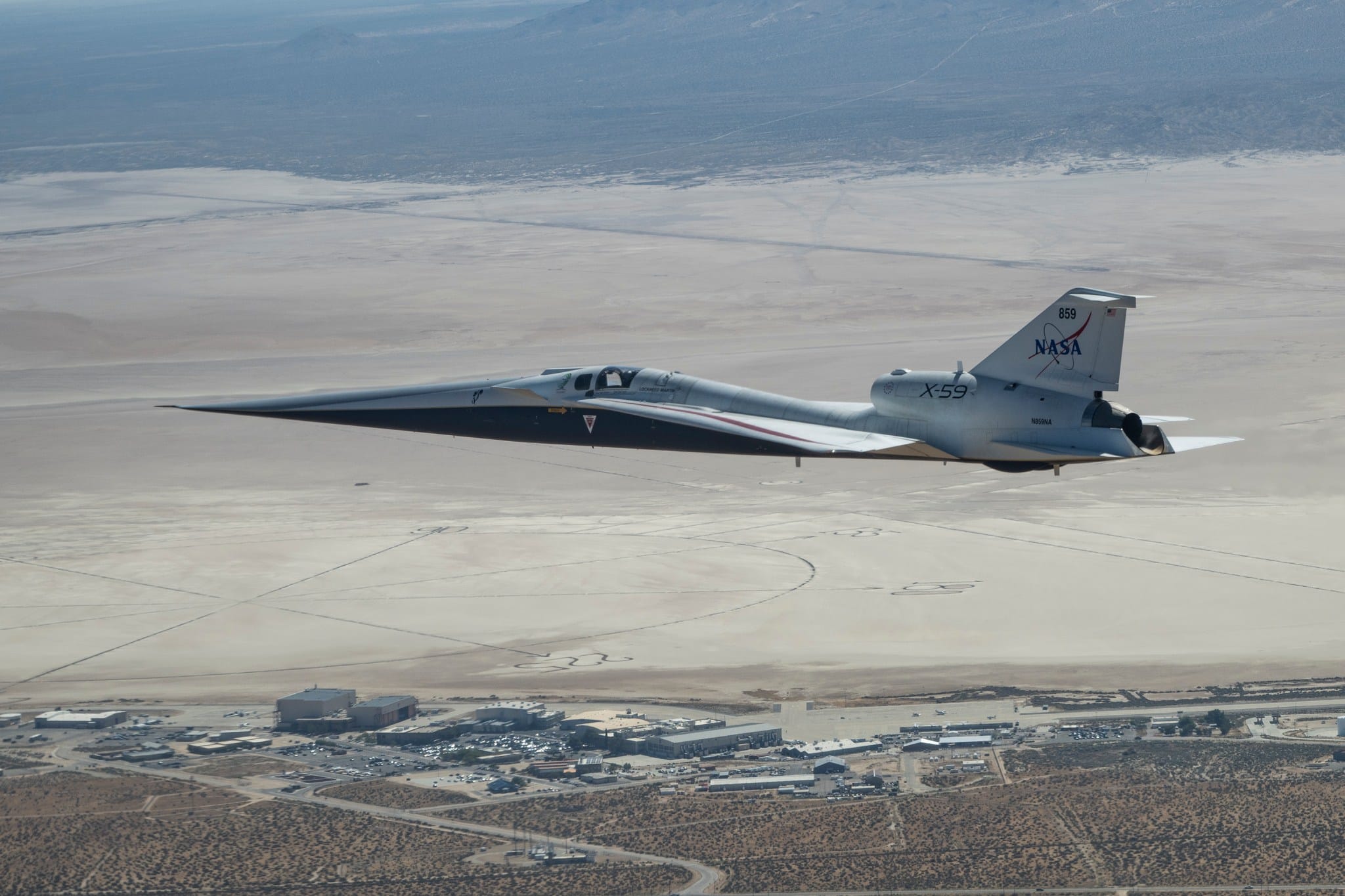
During the April and May flights, specialists are verifying the X-59’s flight characteristics across various landing gear configurations — both retracted and extended. According to NASA, these tests are intended to confirm that the aircraft operates correctly across its full range of operational modes, not only at the cruise supersonic speeds for which it was designed.
- Tests are being conducted over Armstrong Flight Research Center in Edwards, California
- Flights cover both retracted and extended landing gear configurations
- The previous phase included flights at high altitudes and near-supersonic speeds
- Work is being carried out under the Quesst mission
The Significance of a Phased Testing Approach
The methodology of incrementally expanding the test envelope — from high speeds to the full spectrum of operational modes — is typical of experimental aircraft development programs. NASA’s statement notes that the current series of flights is intended to validate the X-59’s performance across a wide range of conditions. The agency is publishing additional details on the progress of the tests on the official Quesst program blog.
The Quesst Program in Context
The Quesst program is part of NASA’s efforts to build the technological foundation for a potential return of commercial supersonic passenger aviation. The central question the X-59 is meant to answer is how quiet supersonic flight over populated areas can realistically be. Data collected during the tests are planned to be submitted to regulators for evaluation. Details on earlier phases of the program and the aircraft’s technical characteristics were previously covered in materials dedicated to NASA aviation research.
Источник: NASA Breaking News




Comments on this article