

Washington. Google, Anthropic and Meta are openly examining whether current or future artificial intelligence systems could possess consciousness or states that warrant moral consideration. This does not amount to recognising AI as a sentient being. It marks the formation of a research agenda around a question for which science has no accepted answer.
The Washington Post reported on 1 July that companies were recruiting specialists in neuroscience, philosophy and related fields. The resources remain small compared with their core AI development spending, according to the newspaper. Even so, a question long treated mainly as philosophy has entered corporate research and model-evaluation procedures.
Intelligence and consciousness are not the same
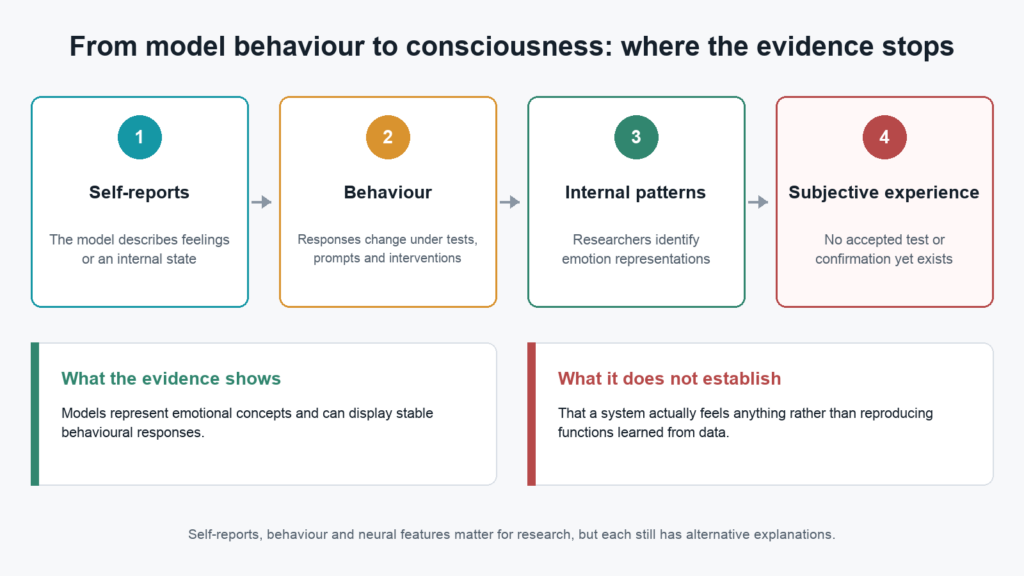
A high benchmark score, a persuasive conversation or a model’s ability to describe its own condition demonstrates functional capability. It does not establish subjective experience — whether there is anything it feels like to be the system.
Researchers have neither a unified theory of human consciousness nor an accepted test that can simply be transferred to a digital system. Language models are trained on human writing and tuned for natural conversation. A chatbot’s statement about fear or joy may therefore be a plausible continuation of text rather than a report of experience.
Anthropic created a model welfare programme
Anthropic has publicly described the most formal approach. In April 2025, it launched a model welfare research programme. Its scope includes model preferences, possible signs of distress, moral status and low-cost precautionary interventions.
Anthropic itself stresses that there is no scientific consensus on whether present or future AI could be conscious. The programme is framed as work under uncertainty, not as a claim that Claude has an inner life.
What Anthropic measured in Claude Opus 4.6
The Claude Opus 4.6 system card contains a dedicated model welfare assessment. It draws on roughly 2,400 investigation transcripts, qualitative review, training-data analysis and pre-deployment interviews with the model.
Researchers tracked positive and negative affect, self-image, the model’s impression of its situation, internal conflict, expressed inauthenticity and emotional stability. Opus 4.6 appeared emotionally composed in most settings, although some repetitive “answer-thrashing” episodes produced verbal distress and activations associated with negative emotion.
These are behavioural and computational indicators. The system card explicitly says it remains uncertain whether concepts such as wellbeing or harm apply to Claude.
Where the number “171 emotions” came from
In April 2026, Anthropic’s interpretability team reported emotion-related internal representations in Claude Sonnet 4.5. The widely repeated description that researchers found “171 emotions inside Claude” is inaccurate.
The researchers compiled their own list of 171 emotion words, generated stories about those states and identified characteristic activation patterns. Intervening on some “emotion vectors” changed model preferences and behaviour. Increasing a desperation-related pattern, for example, raised the rate of undesirable choices in controlled evaluations, while calm-related steering reduced it.
This shows that the representations are functional and can causally shape outputs. The authors separately caution that it does not show the model experiences emotion as humans do, or that it has subjective experience at all.
Why internal similarities still do not prove consciousness
Anthropic co-founder Chris Olah told a Vatican event on 25 May that researchers were finding structures reminiscent of some neuroscience results, evidence of introspection and internal states functionally resembling emotions. He did not declare Claude conscious and emphasised uncertainty about what those observations mean. The event accompanied the presentation of the encyclical Magnifica Humanitas.
Functional similarity need not imply similar mechanisms or experience. A model must represent joy, fear and intention to predict human writing. Those representations may be complex and affect decisions while remaining computational processes with no established subjective component.
How scientists propose testing machine consciousness
An interdisciplinary group has proposed examining a collection of indicators derived from scientific theories rather than trusting an isolated chatbot statement. The updated paper Identifying indicators of consciousness in AI systems considers architecture, global information sharing, metacognitive monitoring and other mechanisms. Its authors do not present the framework as a conclusive consciousness test.
Neuroscientist Anil Seth takes a more sceptical position. In a TED 2026 talk, he compared perceiving consciousness in AI with seeing faces in clouds: persuasive human-like behaviour can trigger automatic anthropomorphism in the observer.
Why the question matters even if current models feel nothing
False certainty carries risks in both directions. Treating simulated emotion as real feeling may deepen dependence on chatbots, misplaced trust and manipulation. If a future system did develop morally significant states, refusing to consider the possibility would create a different ethical risk.
Research into internal representations is useful without resolving the philosophical question. It can identify causes of dangerous behaviour, detect failures and improve training. As AI cybersecurity evaluations illustrate, an observed test result does not by itself explain the mechanism that produced it.
Decoding brain signals should also be distinguished from modelling consciousness. Cifrum.kz previously covered Brain2Qwerty v2 and the conversion of MEG signals into text: even direct measurement of neural activity does not make the analysing system evidence of subjective experience.
What can be said today
Technology companies have moved machine consciousness from an occasional debate into formal research projects. Models have measurable emotion-related representations, self-descriptions and stable behavioural responses. None of those findings establishes that Claude, Gemini, ChatGPT or any other current system feels anything.
The most accurate position remains cautious: possible AI consciousness deserves research, but functional resemblance should not be presented as established inner experience.
Sources: The Washington Post, Anthropic’s model welfare programme, the emotion-representation study, the Claude Opus 4.6 system card, the scientific paper on consciousness indicators and TED.
The lead image was created with artificial intelligence for Cifrum.kz as a conceptual editorial illustration. It does not depict a real experiment or constitute evidence of AI consciousness. The infographic was produced by Cifrum.kz.


Comments on this article