

An international team of physicists has reported direct optical control and readout of an individual erbium-167 nuclear spin in a crystal. The researchers achieved a single-shot readout fidelity of 91(2)% and a coherence time exceeding 0.2 seconds. The work was published in Nature Communications on August 29, 2026. It is peaceful fundamental research aimed at future quantum networks and distributed computing.
The experiment was carried out by Alexander Ulanowski, Johannes Früh, Fabian Salamon, Adrian Holzäpfel and Andreas Reiserer. Affiliations listed in the paper include the Technical University of Munich, the Munich Center for Quantum Science and Technology, the TUM Center for Quantum Engineering and the Max Planck Institute of Quantum Optics.
The short version
- Individual erbium-167 ions were embedded in yttrium orthosilicate and placed inside a cryogenic Fabry–Perot optical cavity.
- The team optically initialized, coherently controlled and performed a single-shot readout of a nuclear-spin qubit.
- The reported readout fidelity was 91(2)%, while coherence lasted for more than 0.2 seconds.
- Erbium emits in the telecom C-band, where light can travel through standard optical fiber with relatively low losses.
- This is a cryogenic laboratory result, not a complete quantum network or a finished “quantum internet.”
How the experiment works
Nuclear spins in solids are considered promising quantum-memory candidates because they can retain quantum states for comparatively long periods. Directly preparing, controlling and reliably reading one nuclear spin with light remains difficult, however, because its optical signal is extremely weak.
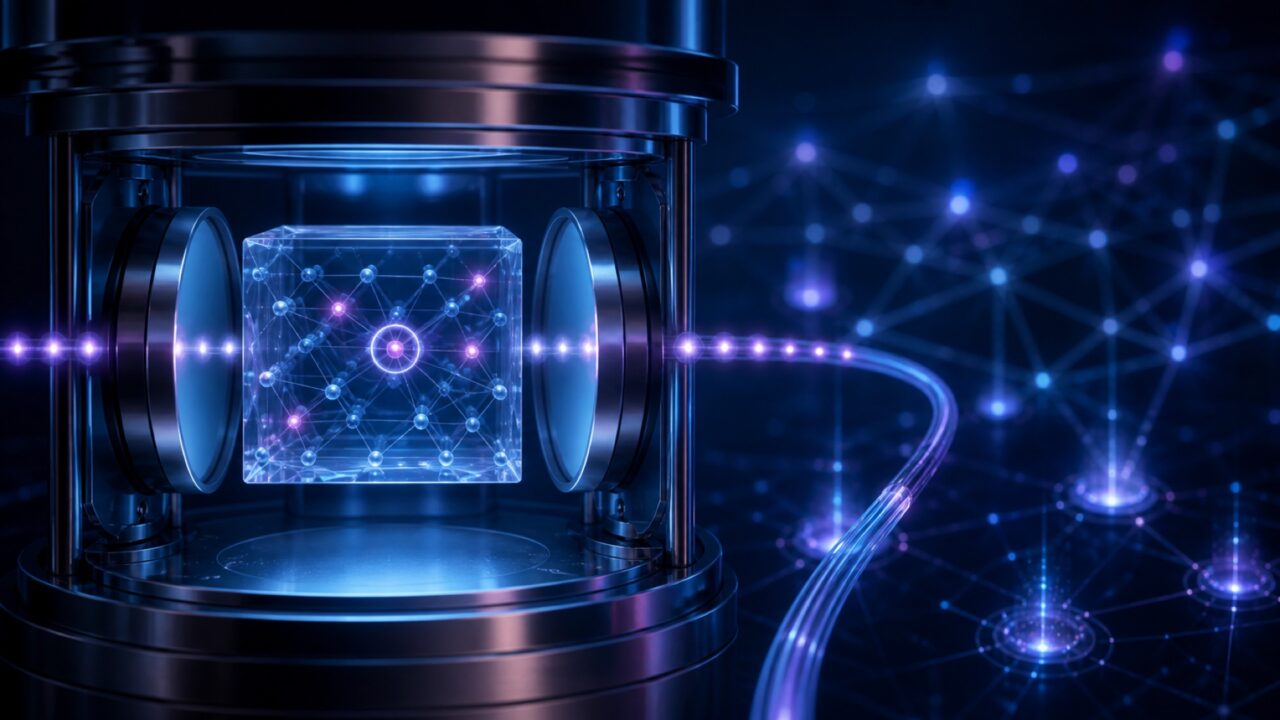
The authors used erbium-167 ions in a YSO crystal and strengthened their interaction with light using a Fabry–Perot cavity. The cavity linewidth was 65 MHz, much narrower than the 0.9 GHz separation between neighboring hyperfine levels. That allowed the cavity to selectively enhance emission from the desired transition and made the qubit state easier to distinguish.
A strong magnetic field also reduced the influence of paramagnetic impurities. According to the authors, this helped preserve coherence for more than 0.2 seconds. A detailed account of the method and its limits is available in the study’s open-access preprint.
Why the telecom band matters
Erbium’s optical transitions lie in the telecom C-band already used for fiber communications. At these wavelengths, light can move through glass fiber with relatively low attenuation. A single physical element could therefore both hold a quantum state and, in a future system, exchange photons over existing fiber infrastructure.
Such nodes are candidates for quantum repeaters, intermediate devices intended to help distribute quantum states over longer distances. Peaceful applications could include linking distributed quantum processors, scientific sensors and research facilities.
Cifrum.kz previously covered how IBM’s Heron processor was used to model a physical process on 104 qubits. The new study addresses a different challenge: not computation within one processor, but a controllable memory that could eventually become part of a network node.
What the result does not yet demonstrate
The authors demonstrated essential operations on a single nuclear spin in a controlled laboratory apparatus. They did not build a complete network, show long-distance transmission over an operational link or announce a date for commercial hardware. A practical system will still require more qubits, reproducible node fabrication, efficient photon handling and reliable operation of many components under one protocol.
It is therefore more accurate to describe the work as a promising experimental platform than a ready-made quantum internet. Its notable feature is the combination of accurate readout, comparatively long coherence and compatibility with telecom wavelengths in one material system.
Sources
- Nature Communications: Cavity-enhanced optical readout and control of nuclear spin qubits
- arXiv: open version of the paper
- TUM Quantum Networks: group publications
Illustration: Cifrum.kz. This AI-generated image is a conceptual view of quantum memory, not a photograph of the TUM or MPQ experiment.



Comments on this article