

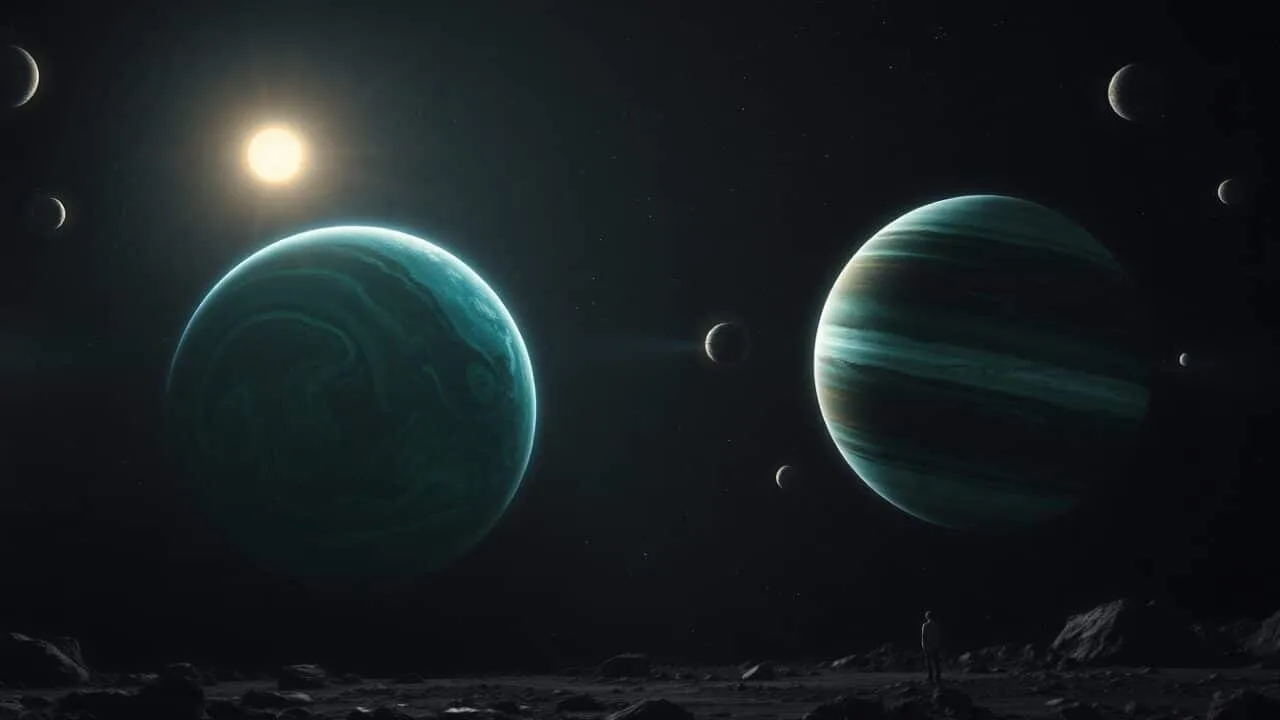
Third Ice Giant: What the Study Says
According to data cited in the Space.com article, new research indicates that the characteristics of Jupiter’s and Uranus’s moon systems are difficult to explain without the involvement of some additional large body. Scientists suggest that in the early history of the Solar System, a third ice giant may have existed — a planet comparable in size to Uranus or Neptune. This hypothetical planet, according to the researchers, was subsequently ejected from the Solar System through gravitational interactions with other planets.
Details of the research methodology and the names of the study’s authors are not provided in the published brief report.
Moons as Witnesses to the Past
The central idea of the research is that the moons of Jupiter and Uranus may serve as indirect evidence for the existence of a “lost planet.” According to the hypothesis, gravitational interaction with a third ice giant during the formation of the Solar System could have influenced the composition and structure of the moon systems of these two planets — either by directly transferring some of its own moons to them, or by altering the orbital dynamics of already existing bodies.
The Solar System today has two ice giants — Uranus and Neptune. If the hypothesis is confirmed, it would mean that in the past there were at least three such planets. The idea that the early Solar System was more densely populated with large planets is not new: a number of previous models have also allowed for the existence of additional planetary bodies that were subsequently ejected beyond its boundaries.
Context: The Instability of the Early Solar System
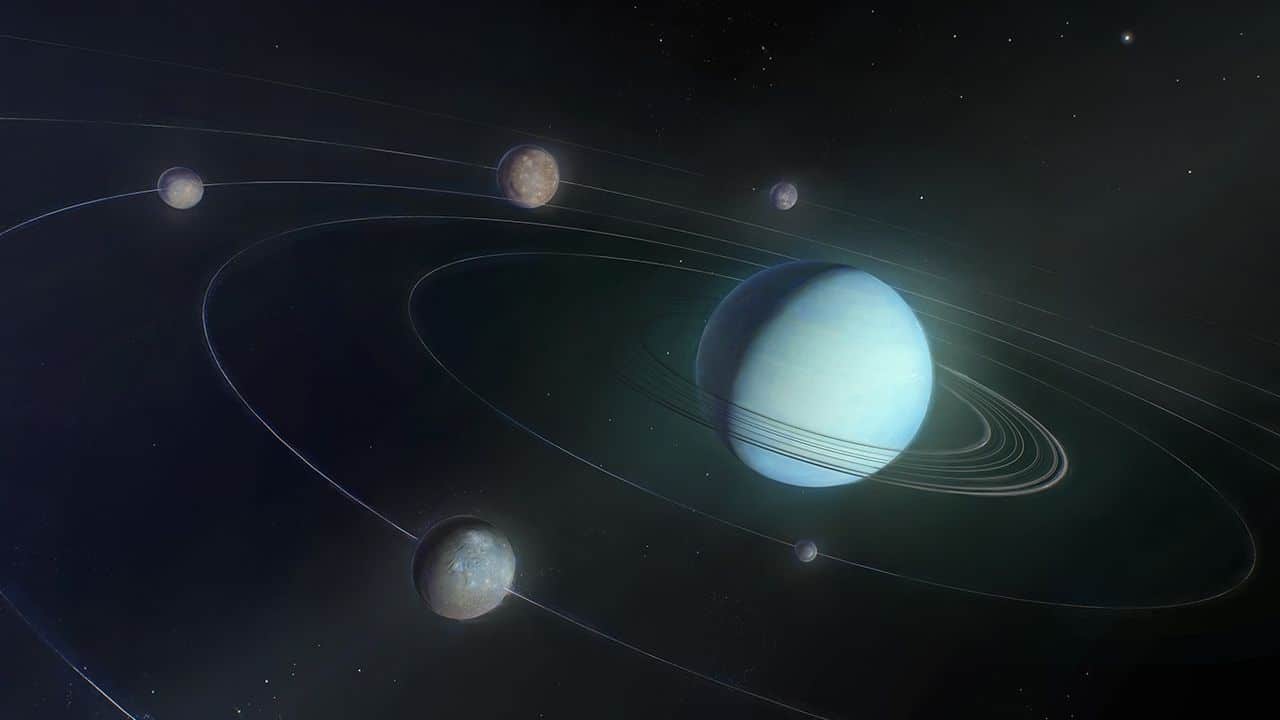
The notion that the architecture of the Solar System underwent significant changes during the first hundreds of millions of years of its existence is widely accepted in planetary science. Dynamic evolution models — in particular, the so-called Nice Model — predict that giant planets may have migrated over considerable distances, with some potentially leaving the system under the influence of gravitational perturbations.
In this context, the hypothesis of a “lost” third ice giant fits within an already established theoretical framework. Nevertheless, confirming it will require additional observational data and detailed modeling.
What Remains Unknown
The brief Space.com report does not disclose key details of the research: the authors of the study are not identified, nor is the journal of publication, the specific characteristics of the hypothetical planet, or the mechanism by which it could have transferred moons to Jupiter and Uranus. No further information is provided in the published material.
At this stage, therefore, this remains a hypothesis requiring further scientific verification, rather than an established fact.
Implications for the Study of the Solar System
If the hypothesis is confirmed through subsequent research, it could significantly alter scientists’ understanding of the formation and early evolution of the Sun’s planetary system. Understanding how the moon systems of Jupiter and Uranus came to be is relevant not only to the study of our own system, but also to the interpretation of data on planetary systems around other stars.
Research into the moons of giant planets is becoming particularly relevant in light of current and planned space missions. In particular, the European Space Agency’s JUICE spacecraft is en route to the Jovian system for a detailed study of its largest moons. The data obtained may ultimately help test such hypotheses about the origin of moon systems.
— *A new study published by Space.com suggests that the moons of Jupiter and Uranus may point to the past existence of a third ice giant in the Solar System. According to the scientists’ hypothesis, this “lost planet” was subsequently ejected beyond the boundaries of the planetary system, but not before leaving its mark in the form of moons around the two largest gas giants.*Источник: Space.com
Related astronomy: Webb has now characterised the atmosphere of WD 1856 b, a planet that survived the death of its star.


Comments on this article