

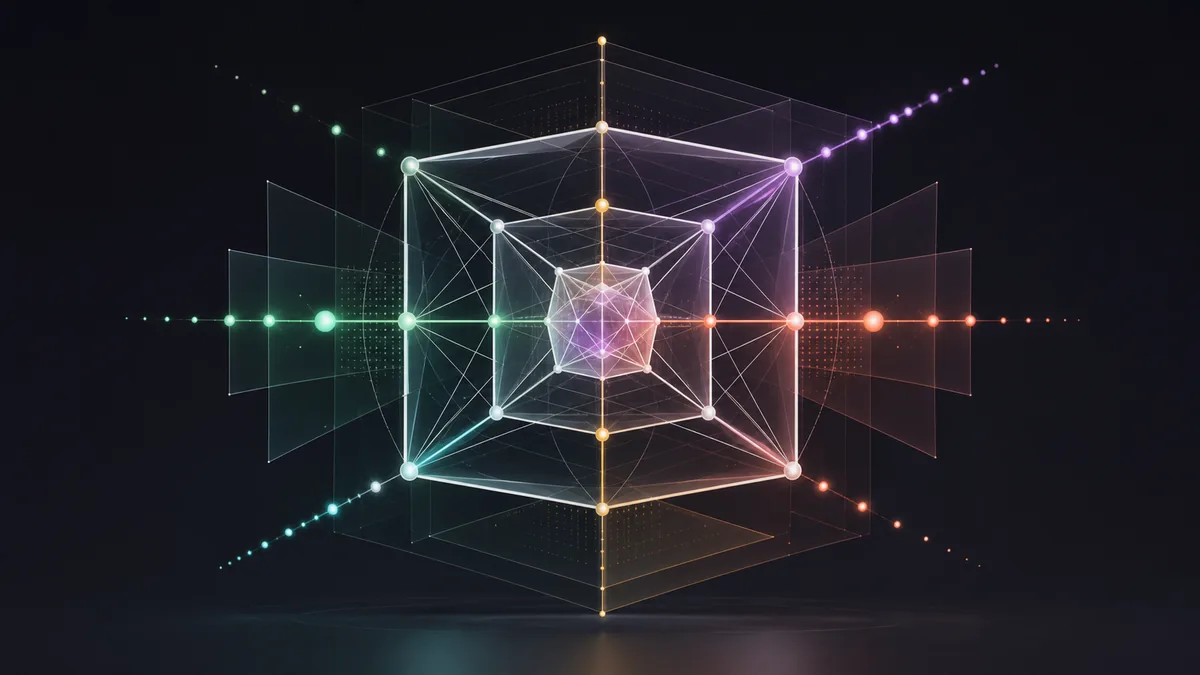
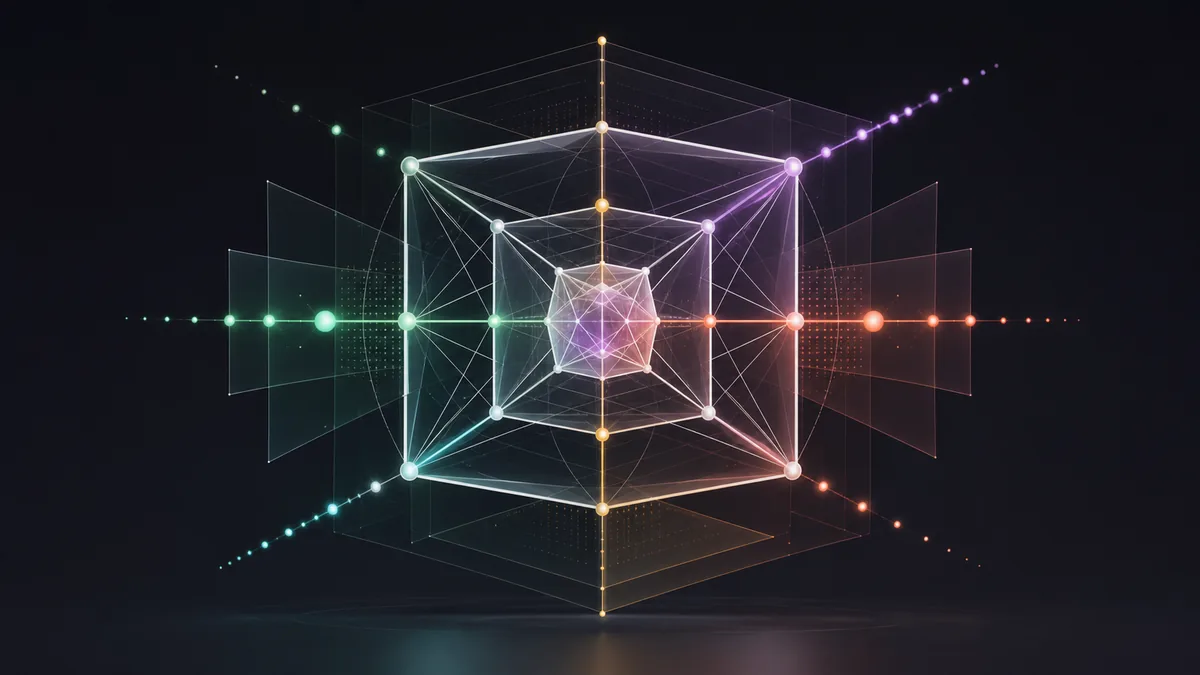
Five-dimensional space sounds like science fiction, but in digital systems it is a practical way to think. Whenever we describe an object with several independent features instead of one number, we are already building a multidimensional space. Five dimensions are a useful teaching model: complex enough to explain how AI works, but still easier to grasp than the hundreds or thousands of coordinates used in modern embeddings.
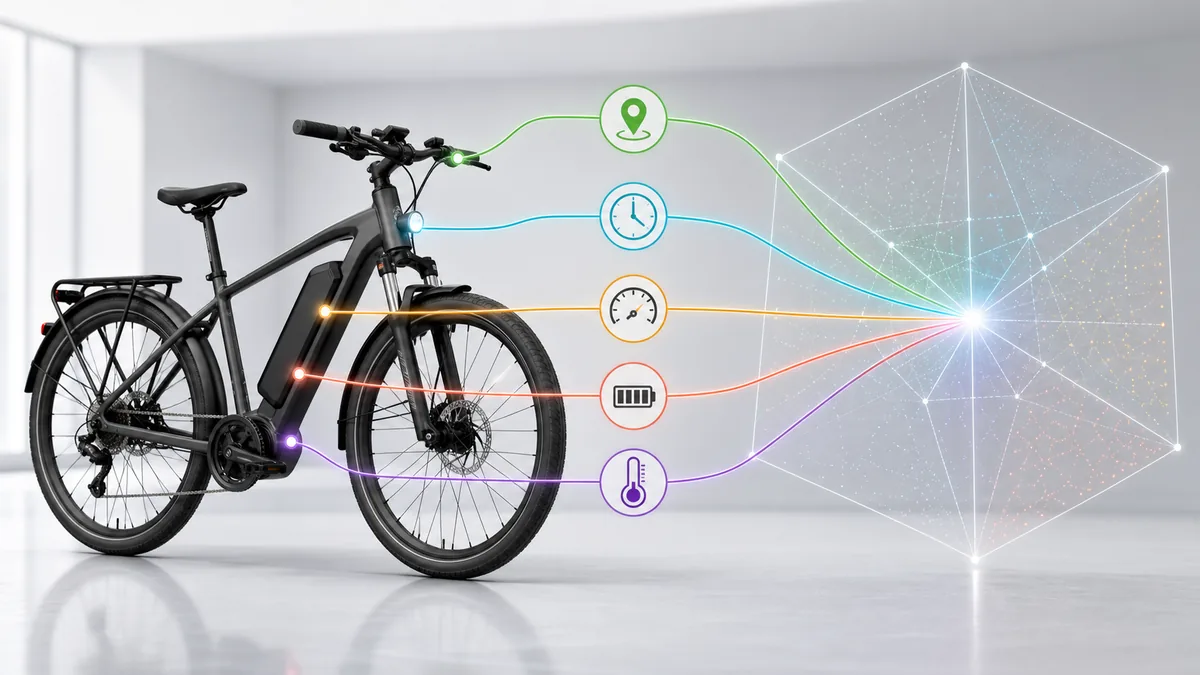
Imagine a courier e-bike. It is not just a dot on a map. We may need its X coordinate, Y coordinate, time, battery level and delivery delay risk. That gives us five coordinates: (x, y, time, battery, risk). The bike now lives in a five-dimensional data model.
What is a dimension?
A dimension is an independent coordinate used to describe something. A line needs one coordinate. A map needs two. A room needs three. Add time, and you can model an event. Add one more signal such as temperature, speed, battery, price or trust score, and the model becomes five-dimensional.
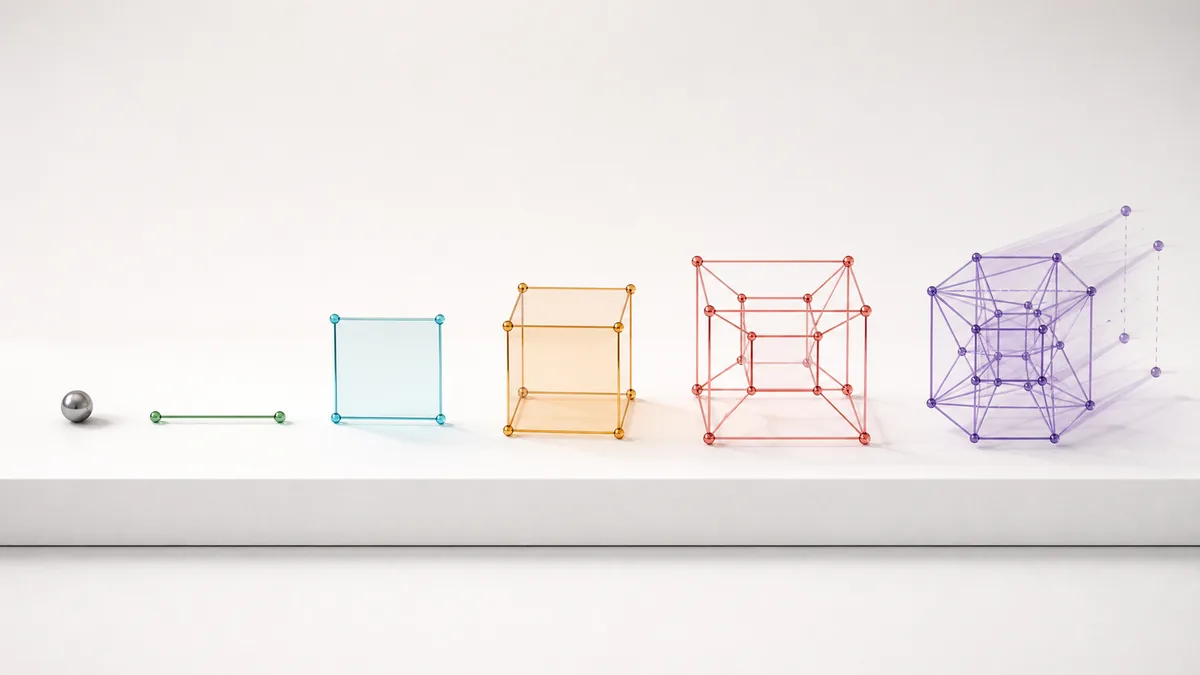
| Dimension | Meaning | Digital example |
|---|---|---|
| 1 | One scale | Product price |
| 2 | A plane | City map |
| 3 | Volume | Warehouse, drone, 3D model |
| 4 | Volume plus time | Object movement over time |
| 5 | One extra important signal | Risk, battery, demand, signal quality |
Physical extra dimensions and data dimensions are not the same
Two ideas should not be mixed. In physics, extra dimensions are discussed as theoretical hypotheses about the structure of the universe. CERN explains that everyday experience gives us three spatial dimensions and time, while extra dimensions belong to theoretical models. In analytics and AI, a dimension usually means a data coordinate: price, time, speed, probability or a vector feature.
So the five-dimensional model in this article does not claim that humans physically see a fifth dimension. It is a way to describe complex objects so algorithms can compare them more precisely.
How an object becomes a data point
Any object can be turned into a list of numbers. For a courier e-bike, it may look like this:
bike_42 = (
  latitude,
  longitude,
  minutes_from_start,
  battery_percent,
  delay_risk
)
If two points are close, the situations are similar. If one point moves far away from the usual cluster, the system may detect an anomaly: battery drain, suspicious routing, sensor drift or unusual demand.
Why this matters for artificial intelligence
Modern AI works with vectors. A text, image, product, query or code snippet can be represented as a point in an embedding space. Google Developers describes embeddings as vector representations where similar items are closer together. In real systems, the number of coordinates is often not five, but hundreds or thousands.
Five dimensions are a mental training model. Once distance in five coordinates makes sense, semantic search becomes easier to understand: it looks for nearby meanings, not just matching words.
distance(A, B) ≈ difference in meaning,
not just exact-word mismatch
How to see what cannot be drawn directly
A five-dimensional space cannot be honestly drawn like a normal cube. Analysts therefore use projections: complex points are placed on a 2D map while trying to preserve important neighborhoods. Methods such as t-SNE and UMAP are commonly used for this. The classic t-SNE paper by van der Maaten and Hinton describes visualizing high-dimensional data on 2D and 3D maps, while UMAP relies on ideas from geometry and topology.
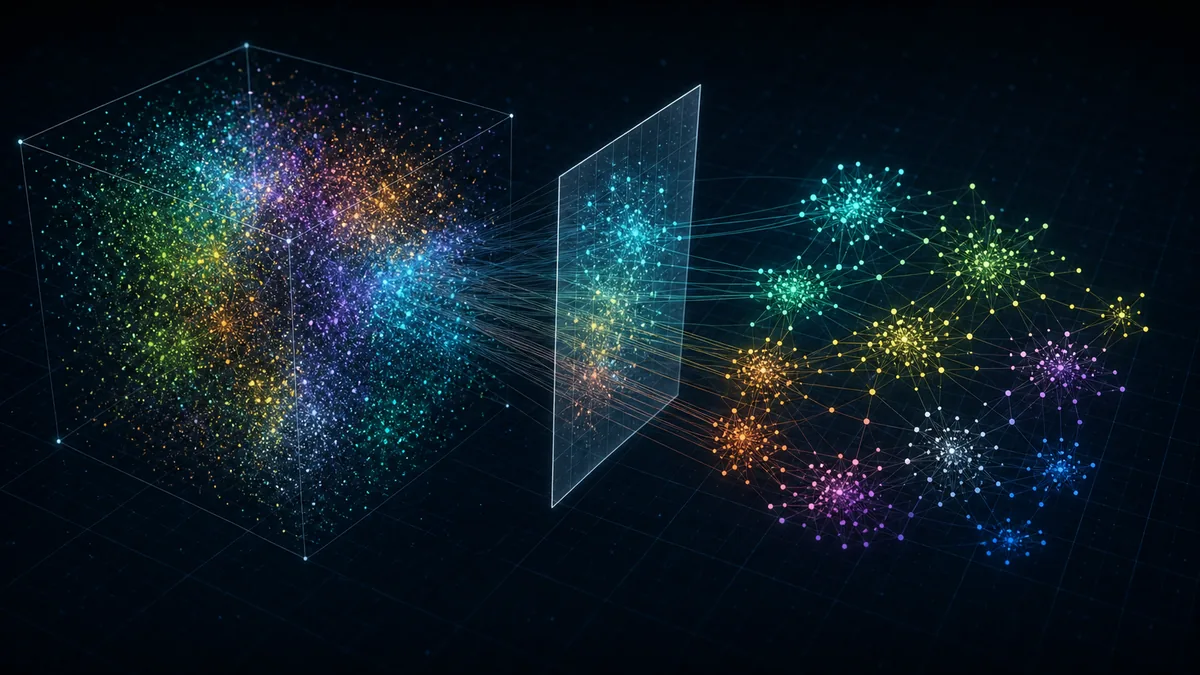
There is a trap: a beautiful map does not always mean a simple reality. Distances can be distorted by projection. Visualization helps ask better questions, but it does not replace data validation.
The curse of dimensionality
When the number of coordinates becomes very large, data behaves less intuitively. Distances may become less meaningful, and noise can look like a pattern. This is known as the curse of dimensionality. Research on high-dimensional data discusses distance concentration and the fact that useful structure often lies on a lower-dimensional manifold.
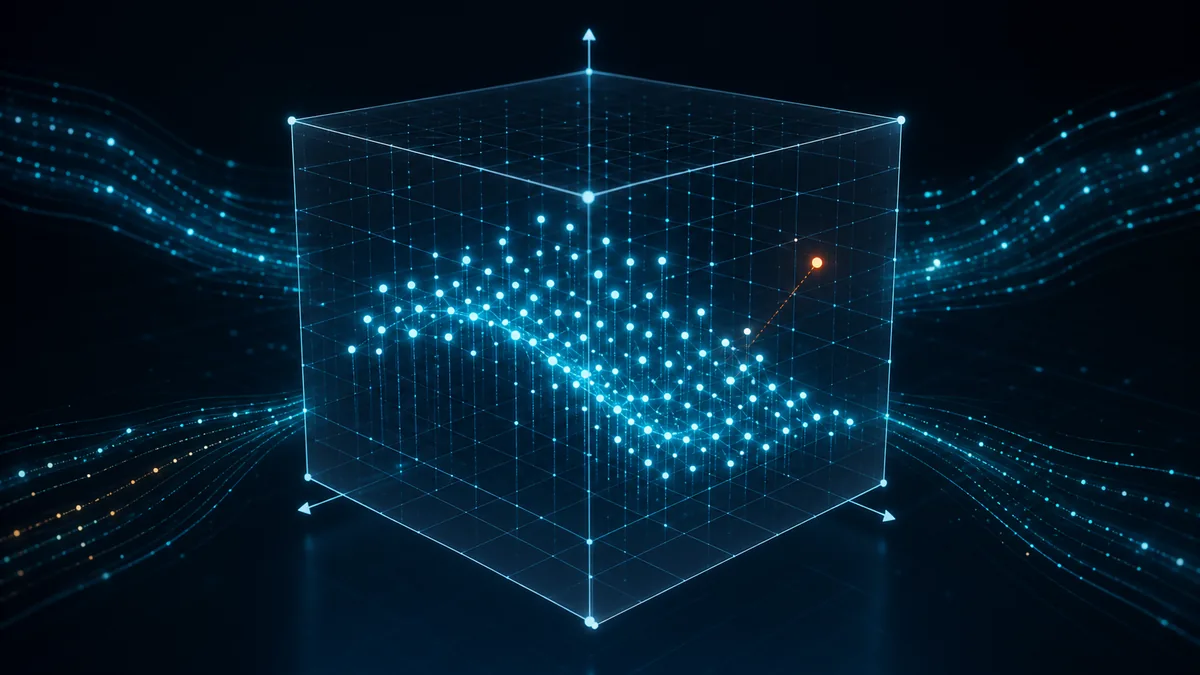
The engineering task is therefore to choose enough features to capture meaning, but not so many that the model gets lost in noise.
Where five-dimensional thinking appears in real products
- Semantic search. Queries and documents are compared by meaning, not only by words.
- Recommendation systems. User, product, price, time and context become coordinates for matching.
- Digital twins. Sensors describe assets through temperature, load, time, location and state.
- Cybersecurity. Systems look for behavior that falls outside the normal event cloud.
- Business analytics. Sales can be viewed through revenue, margin, region, season, channel and return probability.
FAQ
Is five-dimensional space real?
In physics, extra dimensions are theoretical models. In AI and analytics, five-dimensional space usually means a data model with five independent features.
Can we see it?
Not directly. We can see projections, slices and diagrams that show relationships between points.
How is it related to AI?
AI often represents objects as vectors. If vectors are close in embedding space, the model treats the objects as semantically similar.
Why not use as many dimensions as possible?
Extra coordinates can add noise and make patterns harder to detect. That is why engineers select features and use dimensionality reduction methods.
What does dimensionality of digital function space mean?
It is the number of independent parameters a digital system uses to describe a function, object or event: location, time, state, risk and context.


Comments on this article